

By Chris McGuire
Direct-market vegetable and flower growers who want to diversify their offerings should consider adding apples to their existing crop mix. Consumer demand is high, and the supply of locally-grown organic apples is often low. And apple branches can be a great filler for bouquets and arrangements anywhere from the flowering to early in the fruiting stage.
By combining varieties with different harvest times and using simple refrigerated storage, a grower can market apples for six months every year. As growers become increasingly concerned with excessive tillage, apples and other perennial crops offer a way to permanently protect vulnerable soils from erosion.
For all these reasons, my wife Juli and I planted an orchard of apple trees on our organic farm in southwest Wisconsin in 2012. After growing diverse vegetables for eight years, we were ready for the challenge of orcharding. For the past seven seasons, we have gradually expanded our orchard and raised apples alongside our vegetables.
In 2018, with the help of five employees, we grew four acres of vegetables and tended over 850 apples trees in a 1.3 acre orchard. It’s been challenging to add apples to an already complex market farm, and I’d like to share what we’ve learned.
Organic apples are difficult to grow! Many commercial apple growers dedicate all of their time to their orchards: pruning and training trees, scouting for pests, spraying, and harvesting. On a diverse farm with many competing claims on your time, you can’t afford to do that, and so you should plan to simplify and streamline your orchard.
Plan your orchard
Like many market farmers, we started our vegetable farm with much enthusiasm, but without much money. After beginning with a few tools, a small cooler, and a walk-behind tractor, we learned quickly from our experience, and we rapidly refined our techniques and reinvested our profits in more efficient equipment and facilities. This model of farm growth can work on a vegetable farm.
Apples, however, are a long-lived perennial crop which requires a substantial upfront investment. It costs us almost $20,000 in trees, trellis, irrigation and mulch to establish an acre of dwarf apple trees at our farm, and we have to wait three years to begin harvesting fruit from those trees. If everything goes well, we hope to make a cumulative net profit from apple trees six years after planting. It’s very difficult to start an apple orchard on a shoestring budget. You’ll need savings, off-farm income, or sales from your other farm enterprises to pay for planting and tending your orchard during its early years.
In addition, a vegetable grower replants their crops every year and begins each growing season with a clean slate, free to change varieties and growing methods. By contrast, it’s impossible or expensive to make changes in an established orchard. Of the original 135 apple trees we planted in 2012, we’ve replaced 45 because we learned that some varieties were not suited to our farm, and this cost us time and money. We’ve also learned that we should have adjusted soil pH before planting our first block of trees, and consequently we’ve struggled with some micronutrient deficiencies.
Therefore it’s essential to plan your orchard before planting. Apples are a complex crop, with intractable disease and insect pests and many nuances related to training, pruning, fertility, harvest, and storage. I can’t cover all these details in a short article. My goal here is to explain some key issues to think about as you consider adding apples to your farm.
For more specifics on organic apple growing, I recommend A Grower’s Guide to Organic Apples, published by Cornell University Extension. There’s also a wealth of information available online on specific technical issues from other extension and university sources. Michael Phillips, an organic fruit grower himself, has written several excellent books including The Apple Grower: A Guide for the Organic Orchardist and Holistic Orcharding.
Variety selection
Our farm customers have never requested specific varieties of, say, sweet potato. As vegetable growers we’re free to select whatever sweet potato variety tastes good and is easy to grow. Many consumers, however, hold intense loyalties to specific apple varieties. At the same time, there are vast differences between apples varieties in their suitability to organic growing and their regional adaptation.
I don’t recommend most of the mainstream “supermarket” apple varieties (Gala, Braeburn, Fuji, Pink Lady, and so on). Many of these varieties are common because they are suited to desert apple growing regions of Washington, and they can be hard to grow organically in other areas. The supermarket varieties are also remarkably similar in texture and flavor, and you can differentiate your farm by growing more unique and locally-adapted apples.
Disease resistance is important in organic orchards. On our farm, we decided to only grow varieties immune to apple scab, which is a serious fungal disease that can defoliate trees and reduce yield. To control scab, organic growers often need to spray sulfur or liquid lime-sulfur frequently in late spring (visit bit.ly/2SkoXcV to read how one experienced organic orchardist controls scab). We thought it would be nightmarish to follow a rigorous spray regimen at a time of year when we are busy planting vegetables and training new employees.
Overall, we have been happy with our decision: our spraying and management time is reduced, and although the scab-resistant varieties are relatively unknown to consumers, the best ones are delicious and popular with our customers. We’d particularly recommend the varieties Pristine, Williams Pride, CrimsonCrisp, Pixie Crunch, Sundance, Winecrisp, Liberty and Goldrush. One unpleasant surprise for us was that several of the scab-resistant varieties turned out be susceptible to less common fungal diseases such as Elsinoe Spot and Alternaria Leaf Blotch. These diseases are uncommon in conventional orchards because they are easily controlled by chemical fungicides, but they damaged our trees when we made few or no fungicide sprays. We’ve had to spray sulfur several times each year to keep these “minor” diseases in check.
There is a wide range of susceptibility to apple scab among varieties. Even if you don’t want to limit yourself to scab-immune varieties, I strongly discourage planting highly susceptible varieties (e.g., McIntosh, Cortland, Empire, Pink Lady, or Ginger Gold) in an organic orchard. I have known several organic growers who have replaced these varieties after struggling unsuccessfully to control scab.
Depending on your region of the country, it may also be important to consider resistance to other diseases such as cedar-apple rust and fire blight. Varieties resistant to one disease are not necessarily resistant to others: in our orchard of scab-resistant varieties, we do spray to control rusts and fire blight.
For the ultimate in diverse, unique flavors, consider growing heirloom varieties. Some of these varieties are not high yielding or particularly easy to grow, but they can wow the apple aficionados at your markets. We do not grow heirlooms because we decided to stick with strictly scab-immune varieties, but other organic growers have had good results with them. Useful guides to heirloom varieties include Apples of Uncommon Character: Heirlooms, Modern Classics, and Little-Known Wonders by Rowan Jacobsen, Apples of North America by Tom Burford, and Some Antique Apples for Modern Orchards by Ian Merwin (bit.ly/2TlMIOG).
Regardless, I encourage you to grow a mix of varieties. At least two varieties are required for pollination. More importantly, a mix of varieties will extend your harvest and marketing season, allow you to satisfy customers with differing tastes, and will reduce your risk, in case one or two varieties turn out to be unsuitable. Although I recommend a simplified, streamlined orchard, it’s not much extra work to grow a mix of varieties.
Tree size, orchard layout
Nurseries propagate apple trees by grafting scion varieties (Macintosh, Honeycrisp, Liberty, etc.) onto rootstocks (such as M.27 or G.41). Rootstock varieties differ in cold-hardiness and disease resistance, and, perhaps most importantly, the rootstock largely determine the eventual size of your trees, with rootstocks divided into dwarf, semi-dwarf, and standard (full-sized) categories. Your choice of tree size is a key one. Larger commercial apple growers in the U.S., both organic and conventional, almost always plant dwarf trees spaced closely together.
Briefly, the reasons for this are a quicker return on investment (dwarf trees bear at a younger age), ease of pruning and harvest (dwarf trees are easier to reach), better spray coverage in small tree canopies, less disease (dwarf trees have more open canopies with lower humidity), and better fruit quality (the prettiest and best-tasting apples grow in sunny, open canopies). There are downsides to dwarf trees: they have shallow root systems and thus require irrigation and do not compete well with weeds, they require staking or trellising or they will fall over, and they are expensive to establish (more trees per acre and trellising increase the cost of the orchard). We followed the conventional wisdom and planted all of our trees on dwarf rootstocks.
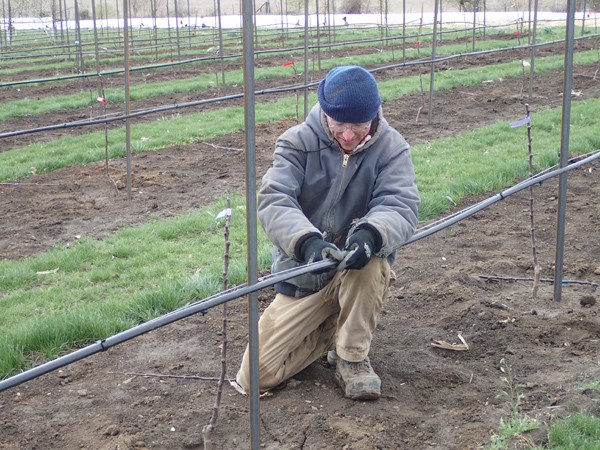
If you do grow dwarf trees, you’ll need to decide how to irrigate, weed, and trellis them. Drip irrigation is common, using polyethylene orchard tubing with emitters built-in at the factory or installed in the field. This will not be difficult for growers who are used to irrigating with drip tape. I strongly recommend permanent, buried header lines for your orchard (we used 1” poly pipe for our buried headers). It’s frustrating to move header lines each time you mow or cultivate the orchard.
Orchards of dwarf trees typically have grass aisles in between the tree rows, with three to five foot wide weed-free strips underneath each tree row. A lush growth of grasses and other plants under dwarf trees will compete with the trees and substantially reduce growth and yield. It is possible to cultivate under the trees using side-mounted tractor cultivators such as the Wonder Weeder or Weed Badger. In a small orchard on a diverse farm, it can be hard to justify the expense of a specialized cultivator and the time required to hitch and unhitch a side mounted implement for each cultivating session. Regular cultivation will also damage soil health and reduce organic matter.
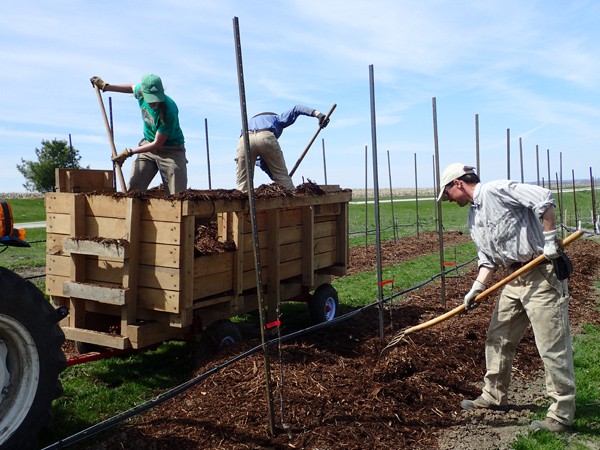
Mulch is the other main option for controlling weeds under trees. Many growers are familiar with straw or hay mulches, but these are not recommended in orchards because they encourage rodents who can then eat tree bark in the winter, girdling and killing trees. Mulches of bark or wood chips do not encourage rodents, and bark in particular is an excellent source of nutrients and organic matter as it decomposes. Landscape fabric will do a good job of suppressing weeds, but we prefer to avoid relying on synthetic mulch, and fabric does not contribute anything to the life of the soil underneath it.
On our farm, we adopted a “we’ll figure it out as we go along” approach to weed control (not recommended!). We cultivated under the trees with wheel hoes and stirrup hoes for two years, found that to be time-consuming and arduous, and then switched to hardwood bark mulch purchased from local sawmills. We now maintain a strip of mulch five feet wide and four to six inches deep under our tree rows.
Downsides are the cost of the mulch (approximately $10 per cubic yard delivered to our orchard) and the time required for mulching (about 4 minutes per trees in our case). Also, our mulched rows still require some hand-weeding for aggressive perennial weeds such as Canada thistle and quackgrass. We made a simple three-point cultivator from off-the shelf components (rolling spiders, sweeps, and disks), and with it we cultivate a narrow strip between the bark mulch and grass aisles to discourage grass from growing into the mulch.
Dwarf trees need support because their shallow root systems will not anchor them securely in windstorms. The main options are trellises with horizontal runs of wire suspended from large wooden or metal posts, or individual metal stakes next to each tree. A closely related decision is the choice of training system for the trees.
The larger-scale commercial apple industry is increasingly moving toward the tall spindle training system or similar approaches, in which trees are spaced very closely (about 3’ apart in the row) and trained to a single vertical trunk, or leader, and no permanent branches. Fruit are produced on short temporary branches which are cut off and renewed repeatedly during the tree’s life.
These orchards bear fruit in their second year and quickly reach peak production with very high yields. However, these sophisticated training methods require close attention to tree training and pruning during the first years of growth, especially in late spring and early summer. That’s a very busy time of year on most vegetable farms. Will you be able to spare the skilled labor and attention to pinch shoots, tie branches, and do the other work needed in an orchard of densely planted trees?
When we started our orchard, experienced orchardists cautioned us against a very high density planting because there is little tolerance for error. Mistakes in the first two years after planting can result in a tree that overgrows its available space, at which point it becomes very difficult or impossible to ever restrict the tree’s size and get a good yield of quality fruit. We’ve planted our trees at a lower density, six feet apart in the row, and supported each tree with a 10’ angle iron stake (from Best Angle Tree Stakes).
We train the trees to a single leader with a tier of permanent horizontal branches about 30-36 inches above the ground. Above that the trees have shorter temporary branches which we cut off and renew during winter pruning when they become too large. It’s a simple pruning method and although we’ve made mistakes we’ve generally been able to recover and get the trees back to good condition over several years. Our trees produce their first fruit in the 3rd year and reach peak yield by about year 5.
In an orchard of more widely-spaced, larger trees on semi-dwarf or standard rootstock, there will be fewer trees to train in the early years. And the central leader pruning method which is used for larger trees is more forgiving of summer neglect, so you probably won’t mess things up completely if you ignore your trees while you’re busy picking zucchini and planting fall broccoli. An orchard of large trees will also require less money upfront, because there are fewer trees to buy and little or no irrigation or trellising is required.
Larger, semi-dwarf trees may be a good choice for the farmer who has some extra land for an orchard but who wants to avoid making a large investment of money or management time. However, an orchard like this will be a long term investment: even mid-sized semi-dwarf trees can take 8-10 years to reach their peak yield. Larger trees will always be more time-consuming to prune and harvest; and they will require a larger sprayer.
The second part of this article appeared in the April 2019 GFM.
Chris McGuire and his wife Juli have farmed at Two Onion Farm in Belmont, WI since 2003. They currently raise organic apples for a CSA program and local grocery stores.
Copyright Growing For Market Magazine.
All rights reserved. No portion of this article may be copied
in any manner for use other than by the subscriber without
permission from the publisher.